
Archive for the ‘Santa Monica Mountains’ Category

“Hey CORBA, Stop Ruining Our Trails!”

Wednesday, February 29th, 2012

By Mark Langton

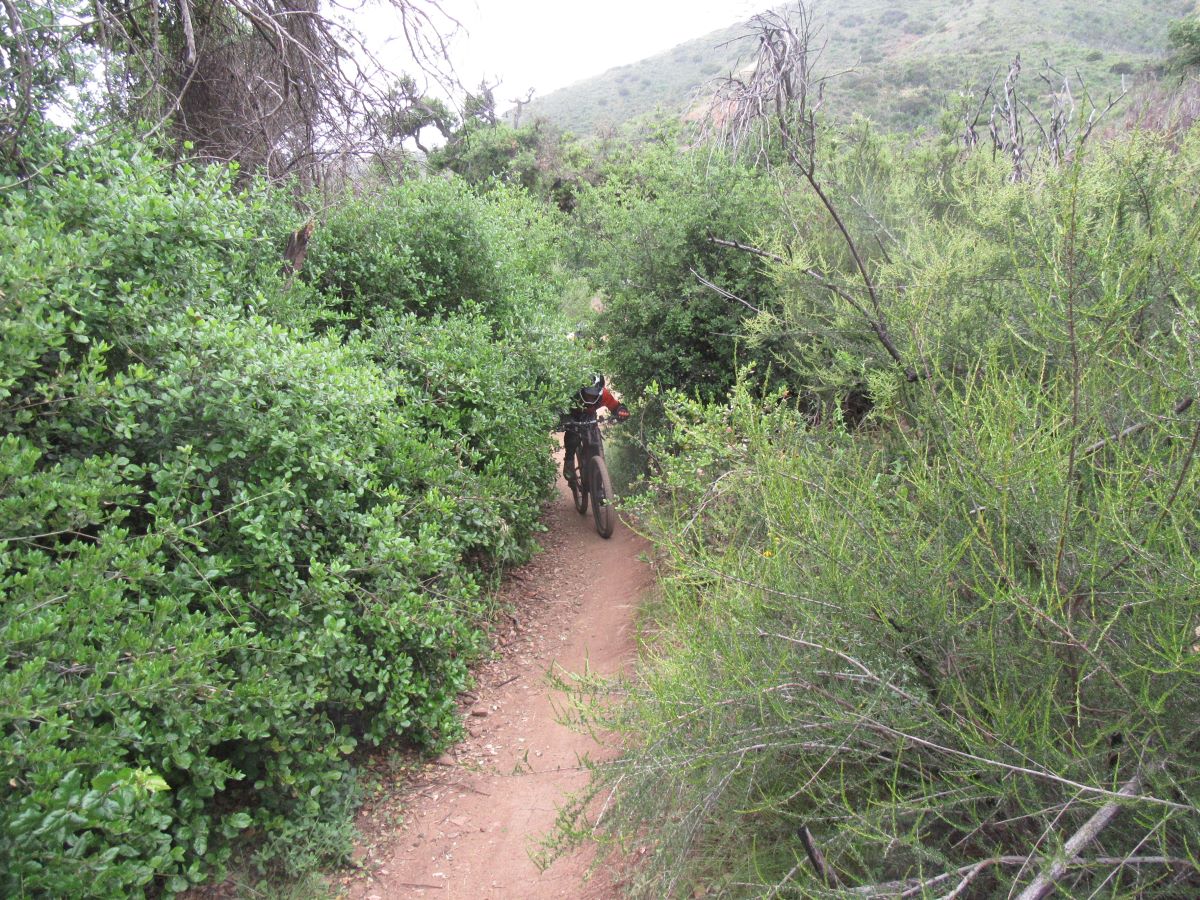
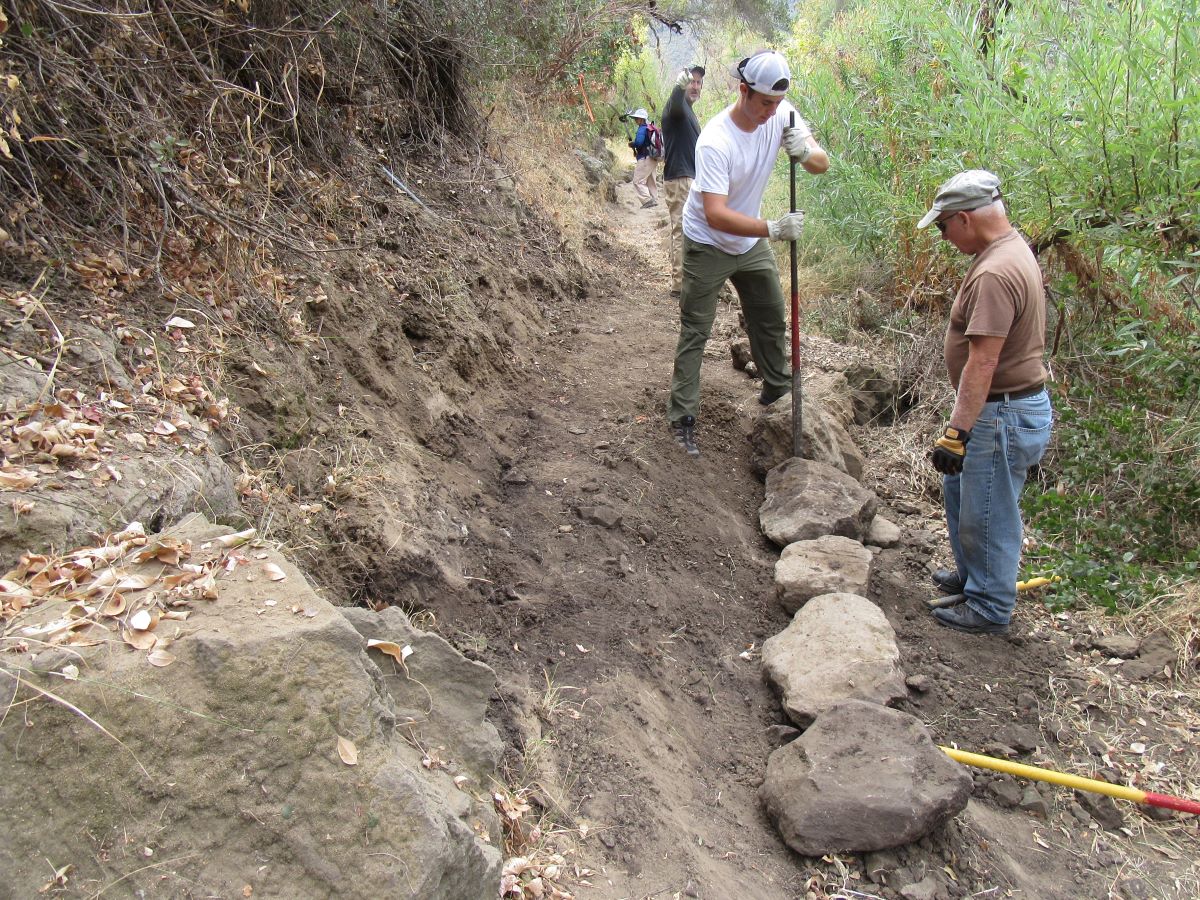
Does this trail look "ruined"?

Seems like every time there is maintenance on our local trails, we hear from some very passionate people within the mountain bike community: “Leave the trails the way they are!” Along with this we also get the usual “How can CORBA do this?” A recent comment even alleged that CORBA is trying to take away our freedoms by doing trail work; “CORBA is conspiring with the State to ruin a beautiful single track trail—The Guadalasca.” As I and several others said in recent blog responses, trails are dynamic, they need maintenance every so often. CORBA doesn’t decide what work needs to be done, but agrees that it does and feels that we should participate as advocates of shared open space trails.

Many times people making these comments start off by saying “I have been riding these trails for several years…” If that were true, then they’d know that trails return to a more natural, “challenging” appearance after any kind of trail work. The Sulphur Springs Trail in Cheeseboro Canyon and Solstice Canyon Trail section of the Backbone Trail are two such trails that come to mind. Both were widened and smoothed over, and many people said they’d be “ruined.” Look at them now; they are as challenging and natural—and fun—as ever.

I’ll admit, I am not always in favor of trails becoming less challenging, but at the same time, I have to balance it with the fact that I can ride the trail in the first place. Guadalasca (and other sections of the Backbone Trail) is open to bicycles thanks to the advocacy efforts of CORBA. Some people might say that even if it were closed, they’d ride it. That’s your personal choice, but I’d like to think that as someone who enjoys the open space, you’d like to do it without the cloud of breaking the rules hanging over your head. Just because you can break the rules, it doesn’t mean you should.

Here’s an analogy I came up with while out riding (always good therapy): Let’s say the agency that maintains the street you live on proclaimed that, due to budgetary constraints, they would only be able to do limited maintenance on the street. The street and sewer system falls into disrepair, so you and your neighbors put together a volunteer group to help the agency; you get trained in road and sewer repair, and enlist other neighbors to help. Still, the street becomes riddled with potholes and cracks because the agency just can’t afford the materials and equipment to do the repairs. Soon, off-road vehicle owners start using your street to challenge their vehicles’ capabilities because there’s nowhere else nearby they can do it, which make the street conditions worse. Not to mention these vehicles can go much faster than the passenger cars most of you and your neighbors are driving, making it unsafe for you and your neighbors to even drive down the street. You caution the off-roaders that they shouldn’t drive their vehicles on your street, especially at high speeds, because it is creating an unsafe situation, but they still do because “it’s public and they have a right to drive there. And besides, we’re not going that fast.” Finally, after several years, you and the agency start making repairs, but the off-roaders keep coming and start complaining that you are ruining their fun zone. They come to your volunteer maintenance days and complain you are making the street too smooth and it’s no fun to drive there. They write letters to you saying you are trying to take away their freedoms. All because you are trying to do the right thing for your community.

Here’s an idea: The next time you think someone is trying to take something away from you in your local riding area, ask yourself, “what can I do to help improve the situation?” That could mean getting more involved with your local community. Or it could mean going someplace where the trails are more challenging, where riding them at higher speeds does not impact the rest of the trail user community. Such places exist, whether it be a race or a bike park like Mammoth Mountain. Our local trails are for shared use by many different types of users, so you’re just going to have to adjust your riding style accordingly. Kind of like on the street when driving your car or motorcycle; you may have a high-performance vehicle, but to drive it to its capabilities on public streets just wouldn’t smart or safe. Just because you can break the rules, it doesn’t mean you should.


Guadalasca Trail Work Report and Photos for February 25, 2012

Monday, February 27th, 2012

This past Saturday, 22 mountain bikers, eight or so members of the trail crew from the Santa Monica Mountains Trails Council (SMMTC) and two California State Parks (CSP) staffers gathered at the bottom of Guadalasca Trail in Point Mugu State Park for a few hours of trailwork.

This was the first of several days of work that have been planned for Guadalasca this spring. We have previously blogged about the overall changes that are coming.

Much of the trail looked like this photo taken a few days before we did our trailwork

Originally we had planned to carpool down to the trailhead from the meeting point at the south end of Wendy Drive in Newbury Park, but the fantastic turnout of mountain bikers meant there would be too many cars to park at the limited area on Wood Canyon at the bottom of the trail. Instead, we caravanned to the Danielson Multiuse area where there’s lot of parking, then jammed into three trucks and vans after transfering the tools to the Gator utility vehicle. From there we slowly drove to the trailhead.

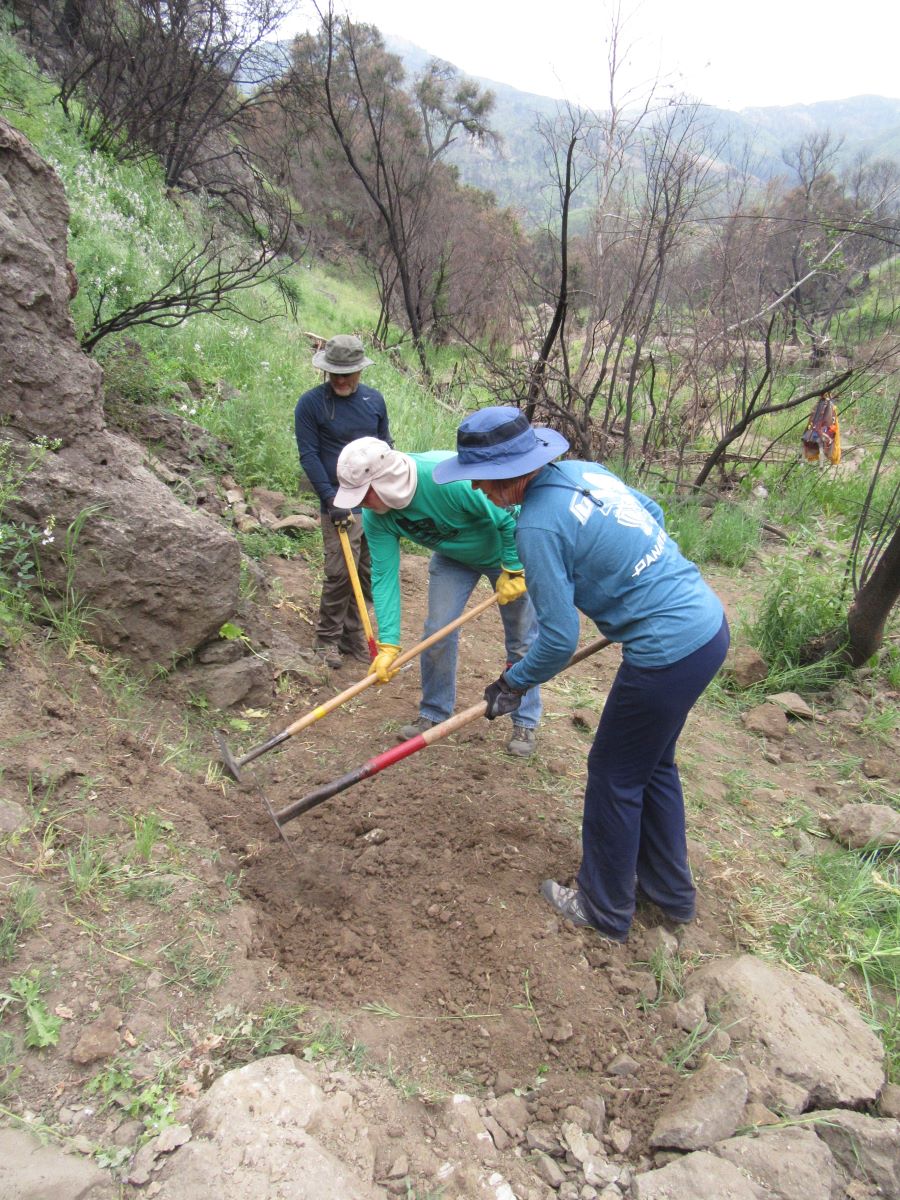
The work for the day was to clear the brush from the downslope side (outside) of the trail along as much of the old ranch road section of the trail as we could. The CSP standard for multiuse trails is that the trail corridor should be clear of brush for 8′ of width and 10′ of height. Even though the trail will evenutally end up being only 1 – 3′ wide, the extra width at the side provides better sight distances so trail users can see others approaching from further away. Also, it takes several years for the brush to clog the trail again, so we don’t have to clear it out every year. For this trail, there are other reasons to widen its corridor, presented here in near- to long-term order:

  • It allows access for the Gator to carry tools up for us on future trailwork days
  • The two seasonal streams that this trail crosses near the bottom currently are drained through partially blocked and damaged culverts. The culverts will be removed and replaced by level crossings. The wider trails will provide access to the excavating equipment that will be required for this
  • Most importantly, the long-term objective is to move the trail to outside edge of this old road bed, and clearing the brush on the downslope side will make the room for it. When the trail is closer to the downslope side, it will be easier to shape so the rainwater runs off, thus reducing the amount of maintanence it requires to fix the ruts

Volunteers clear brush on the downslope side of the trail to make room for the trail to be moved to the outside of the old road bed. Once moved, brush will be allowed to regrow on the upslope side, narrowing the trail corridor again

As we were working, about 15 – 20 mountain bikers passed us. With one notable exception, they all thanked us for helping to keep the trail in great shape for riding.

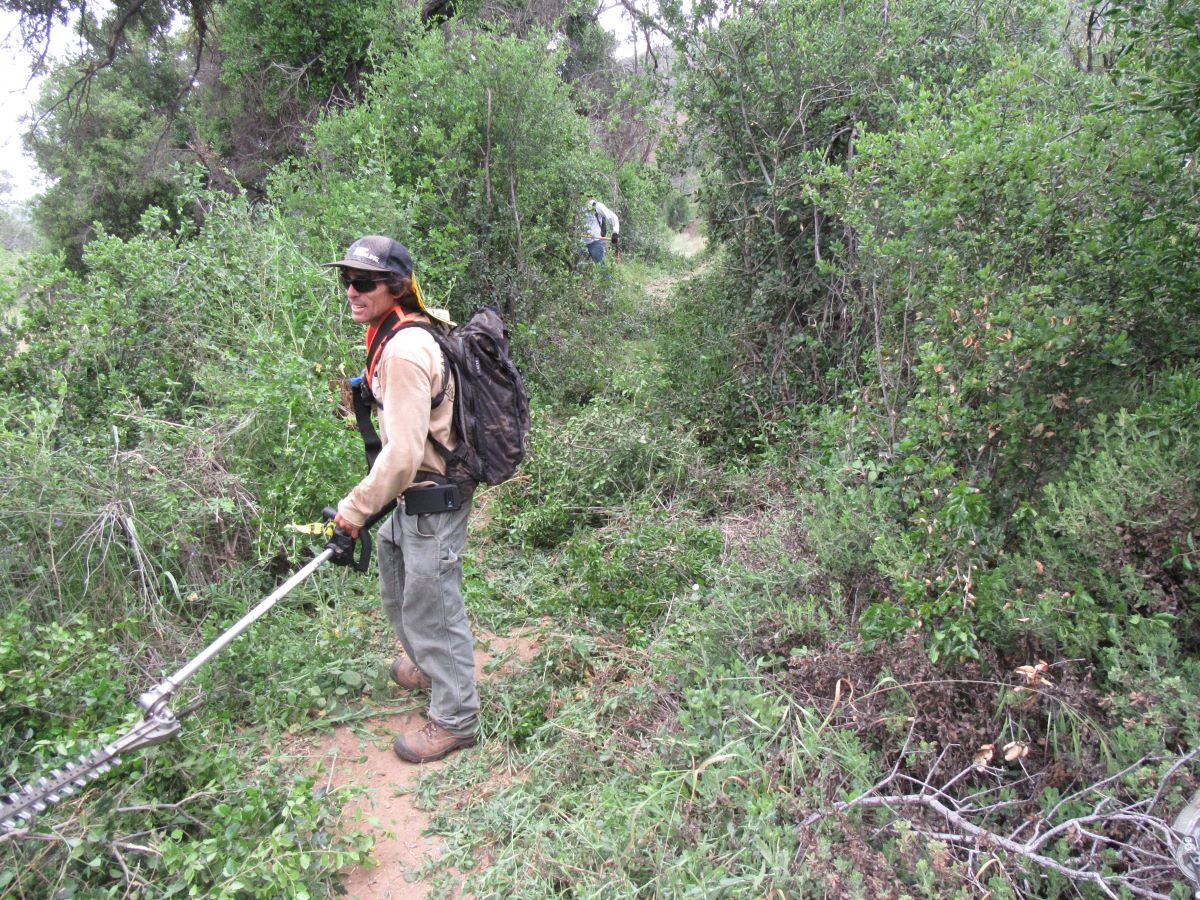
With less than four hours of work, plus breaks and travel time, we cleared out the bottom 0.6 miles of the trail, about 3/4 of this section. CSP staff brought a chain saw and the SMMTC crew brought a power hedge trimmer. Both these tool greatly sped up the work and allowed us to clear much more than we would have been able to otherwise. The hedge trimmer was also a great help in cutting out the poison oak that was starting to regrow in several places.

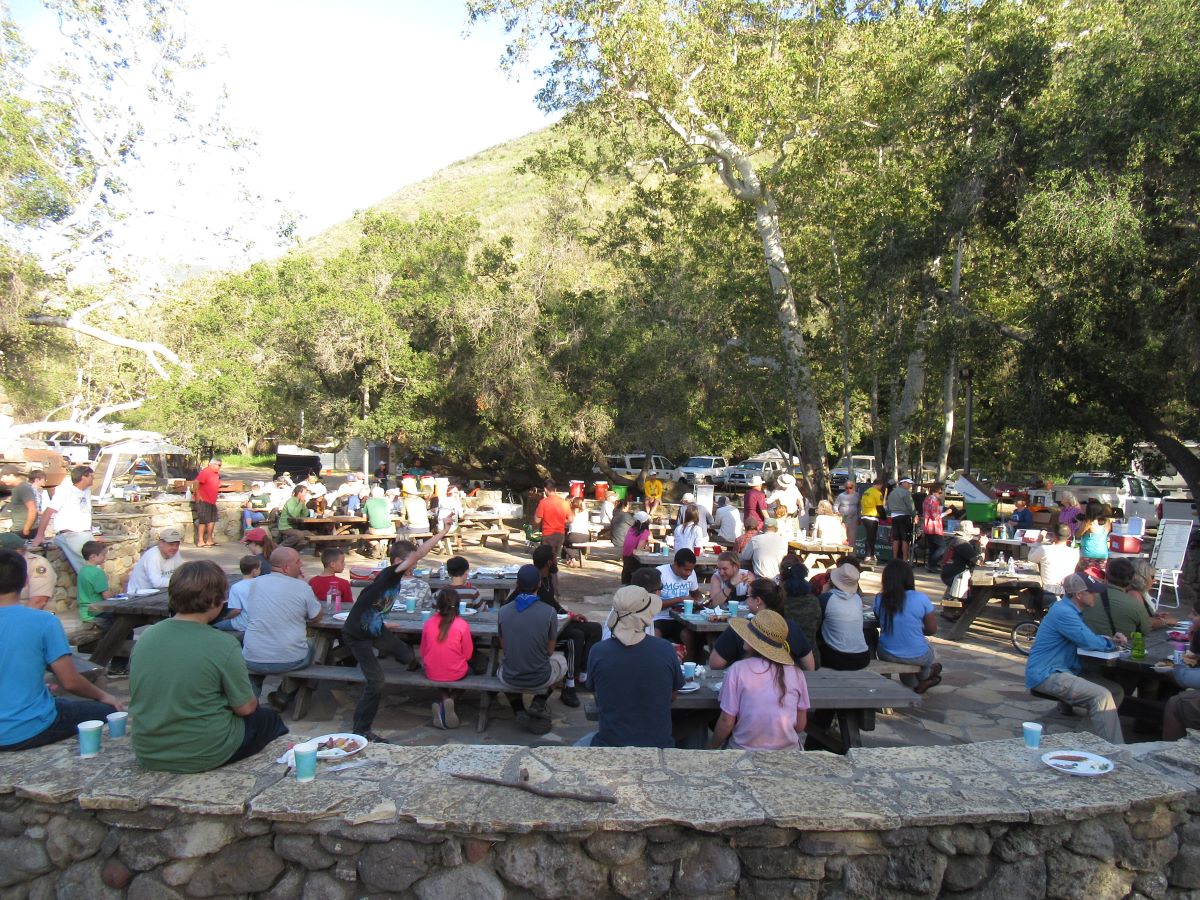
A little after 1:00 pm, we headed down the trail to shuttle and caravan out. Back at the cars, we had the prize drawing, then drove down to a new barbecue joint a mile or so away. I think everyone agreed it was a great place to eat, and not as expensive as other similar places.

We have another event scheduled for March 17th to continue clearing the brush on the old ranch road, and beyond if we have time. Work should go much faster because most of the brush at the top end of this section is low chaparral, rather than tall chaparral and trees. If you would like to help out, please use our online form to register in advance.

Take a look at our photo gallery of Saturday’s trailwork!


Save the Date: California Trails & Greenways Conference, April 18-20, 2012

Thursday, February 23rd, 2012

The California Trails & Greenways Conference is

Coming to Los Angeles!!!

Excitement is building as California State Parks and its trail allies prepare for the 27th California Trails & GreenwaysConference taking place April 18 to 20 at the Woodland Hills Marriott.

Conference registration is scheduled to open February 22nd. For the registration link and further details about the 2012 California Trails & Greenways Conference, including sponsor, exhibit and raffle donation information log onto our website at www.parks.ca.gov/trails/conference or call 877.776.3619.

The California Trails & Greenways Conference is a forum for networking and building support for accessible, inter-connected, quality trail systems; and a venue for trail professionals and advocates to learn practical, up-to-date, trail skills.  This endeavor by California State Parks and the California Trails Conference Foundation helps ensure effective trail stewardship and leadership for generations to come.

The California Trails & Greenways Conference provides opportunities to:

  • Network with, and talk directly to, California’s leading trail experts
  • Find collaborative partners to build support for trail endeavors
  • Learn a full range of trail topics in high quality, innovative sessions
  • Experience hands-on learning through day-long field workshops
  • Address your specific concerns through our table topic sessions
  • Explore exhibits featuring innovative trail-related products and services

All activities are designed to increase the knowledge of trail, recreation and wild land management professionals and advocates, both novice and expert, in order to improve non-motorized, recreational and heritage trail systems and programs throughout California.

Day-long workshops, 27 concurrent sessions, keynote presentations and exhibits all serve to draw California’s leading trail designers, builders and managers to this 3-day event.  The theme for the 2012 Conference is “Navigating Radical Change — The New Normal.” With attendance expected to reach 500, we anticipate the theme will elicit stimulating and creative discussions that will generate new ideas and partnerships.

We live in a tumultuous time, unprecedented in many respects. Believing that “knowledge is power,” the 2012 California Trails & Greenways Conference will explore the multiple challenges facing trails and public lands, what’s known about the trends affecting those challenges, and how to pursue creative solutions while preserving the integrity of the resources we hold dear. We’ll also explore innovative approaches and new collaborations that may inspire your own new solutions for navigating the path ahead.


The preliminary schedule for this 3-day event is as follows:

  • ·        April 18th, Wednesday

o       Optional day-long workshops

o       Exhibits open at 4:00 p.m.

o       Opening reception, dinner, keynote presentation

  • ·        April 19th, Thursday

o       Concurrent sessions throughout the day (5 sets)

o       Awards & Remembrance Luncheon

o       Celebration reception, dinner, keynote presentation

  • ·        April 20th, Friday

o       Breakfast with Table Topic Discussions

o       Concurrent sessions (2 sets)

o       Closing plenary

o       Conference ends at 1:00 p.m.

Planning is also underway for the 3rd Annual Hike, Bike, Ride, Run Event taking place Saturday, April 21st. This post-conference outing and BBQ is a wonderful way for all trail users to come together to show that we can share our trails and all get along. Conference attendees and friends are invited. Reservation and other details will be posted on the conference website March 1.

For further details about the 2012 California Trails & Greenways Conference, including sponsor, exhibit and raffle donation information log onto our website at www.parks.ca.gov/trails/conference or call Lauralee at 877.776.3619 or541.547.3640.

Stellar Weather Graces First Two CORBA Kids Rides of 2012

Friday, February 17th, 2012

The CORBA Kids Club started the New Year off right with a return to Sullivan Canyon in January and a Malibu Creek Park ride in February.

January’s Sullivan Canyon ride saw the kids improving their skills, with everybody riding over the cement waffle blocks that most of them walked in December.

The downed tree still blocked most of the main trail, and we used this as an opportunity for a snack break before heading back to the cars. Everybody showed great improvement on the hills. Five adults and six kids participated.  Check out the pictures from this great ride.

The CORBA Kids Club explored the Grasslands Trail during February’s Malibu Creek State Park ride. Dave taught the kids how to do a break-check on their bikes, discussed proper helmet fit, and how to handle horses on the trail. The morning started out cold, but everybody was pealing off layers by the time we hit some of the big hills. The skies were clear, the air was fresh, and it was a perfect day for a ride. We had the single-track route pretty much to ourselves until we came across a large group of MBU trainees on our way back.

There was a very challenging hill before our first break, and most everybody walked up, but two of the kids went down it twice. We also did some hiking sans bikes, all of which you can see on the photo gallery for this ride. Four adults and four kids, including two first-timers, participated. There is a lot more to explore in Malibu Creek State Park, so we will be back there in March.

Hope to see you at the next ride:
Saturday March 3 in Malibu Creek State Park.  Meet at 9 a.m. in the lower parking lot near the wooden stairs. Email kidsclub@corbamtb.com for more information.

Guadalasca Trailwork in Pt. Mugu State Park on Feb 25th

Thursday, February 16th, 2012

The lower section of Guadalasca where we'll be working Feb 25th

On Saturday, February 25th at 8:30 am, we will start on major improvements to the Guadalasca Trail in Point Mugu State Park that will take place over the next year or so. First, the lower section (part of  the old ranch road), will be brushed out to temporarily widen it. This will allow access for motorized equipment that State Parks staff will use to remove the existing culvert drains and convert them to level crossings. Also, the trail will be moved to the outside (downhill side) of the trail and outsloped to allow for better drainage, lowering the need for future maintenance so we will be able to spend more time riding and less doing trailwork.

You can read about the rest of the planned improvements for this trail in our earlier blog post.

Some volunteers have already signed up with our on-line registration form, but we need many more to get this work completed!

View our trailwork page to learn more about trailwork, what you should wear to protect yourself from dust and scratches, and what you should bring along. CORBA will provide the tools and training on how to use them safely. The on-line registration page lists the details of when and where to meet.

Remember, by registering here to help out, CORBA will treat you to lunch afterwards, and enter you in the drawing for mountain biking prizes!

This trailwork day is a joint effort with the Santa Monica Mountains Trails Council trail crew.

We have other trailwork events scheduled for later in the year. Here’s a list of what is currently planned:

April 27-29
State Trails Days in Pt Mugu State Park

April 14
Guadalasca Trail

March 24
COSCA Spring Trailwork Day

March 17
Guadalasca Trail

(You can get more information on these events by clicking on the date.)

State Parks Upgrading Tapia Spur Trail

Wednesday, February 15th, 2012
Stakeholders from several groups inspect the upgrades

Stakeholders from several groups inspect the upgrades

On February 14, 2012, CORBA board member Steve Messer met with State Parks officials and representatives from hiking, conservation and equestrian groups. Together they walked the Tapia Spur trail which was slated for upgrades meet multiple use standards last year. The trail remains open to the public, though the work is well underway.

Originally constructed in the mid nineties, since being opened to multiple use there have been some reports of user conflicts, mostly due to excessive speed of bicycles. This was exacerbated by poor sight lines with blind corners and switchbacks.  One of the significant trail upgrades is a reroute that will eliminate four switchbacks. The new section is still being machine cut, and like the rest of the trail, will be extensively hand-finished.

The entire trail is being re-cut to a 5′ width with a Sweco. Visibility is being improved on many sections by cutting back brush and, where appropriate, cutting back the backslope. The entire trail is being outsloped for improved drainage and to reduce long term maintenance needs.

The most significant change is the inclusion of approximately 17 “pinch points.”  These consist of large 500 pound-plus rocks at least 18″ high strategically placed on the uphill side of blind corners. They will be embedded into the tread and placed about 36″ apart, in such a manner as to require a bicycle to weave between them. This will slow down cyclists at the spots with the most potential for startling of other trail users. These features are a key component of IMBA’s recommended speed control measures. They can add challenge and fun to a trail for cyclists, while allowing horses, hikers and personal mobility devices to pass easily. But most importantly, they improve the overall safety of the trail.

Flags show approximate locations of pinch point rocks

Flags show approximate locations of pinch point rocks

Another feature being added at key locations on the trail are rock-armored swales. The rock armoring leaves a rough tread while also protecting the natural drain from erosion by water or trail users. The rough tread is also expected to slow cyclists and add interest and challenge to the trail. Rocks were being imported from Malibu Canyon to create the pinch points, and harvested locally for the rock-armoring and rip-rap. The heavy rocks were being brought up the trail on mechanized carriers.

According to Knapp, “these features will slow cyclists and reduce the potential for them startling other trail users. We hope that good trail etiquette will then kick in and reduce conflict. However,” he continued, “we can’t control attitude or behavior.”  We concur, and will continue encouraging proper etiquette through our outreach and education efforts, including our free Mountain Bike Skills Clinics.

Knapp also commented on the mission of the State Park to protect the natural resource. “Trails are there for people to enjoy the resource,” he said, “not for thrillseeking.”  He talked about the fact that they must adapt to the changing trail user demographic, while keeping within their mission. These multi-use standards and the objective Change In Use process are a part of that adaptation to accommodate the growing number of off-road cyclists.

Everyone present seemed pleased with the trail improvements. “I like what I see,” remarked one of the Santa Monica Mountains Trails Council representatives “we’ll just need to give it a chance.”

Tapia Spur Re-Route being cut

Tapia Spur Re-Route being cut

The trail improvements are not inexpensive, and funds are being funneled to this project from Sacramento. The State’s new Change In Use procedures will hinge upon their ability to implement these design standards on trails that are candidates for a change to multi-use, but currently closed to bikes. CORBA has a long-standing list of requests for trail Change In Use in the Santa Monica Mountains. While Tapia Spur was already designated multi-use, the upgrades will hopefully allay the concerns of the trail community at large about the pending changes to Lookout and Yearling trails. These two trails have been recommended for a change in use, and could be the next to receive such a treatment.

The trail will be showcased at the upcoming Parks Conference and the Trails and Greenways Conference. The work is expected to be completed by the first week of April. L.A. County is considering implementing a similar trail review process for County trails in the Fifth District. Overall, we believe improvements will not negatively impact the user experience for cyclists, and by reducing conflicts, they will in fact enhance the experience for all users.


(more…)

February 4th 2012 Skills Clinic Photos

Sunday, February 5th, 2012

We had a good-sized class today with 25 participants in this month’s basic skills clinic at Malibu Creek State Park. The cooler months are a good time to take the class because the lower attendence means you get more attention, and today the weather was perfect for riding! The pool of water in the creek was pretty deep again this month so we had some good splashes. You can see all the photos in the February Skills Clinic Photo Gallery.

CORBA comments on Topanga General Plan

Monday, January 23rd, 2012

Topanga State Park General PlanAs we reported last year, a new Topanga General Plan is being developed by California State Parks. The plan will guide Topanga State Park’s future, ensuring that management practices are in line with the mission and objectives of the Park.

The general plan does not govern trail use designations, and instead defers to the Santa Monica Mountains Trails Master Plan, which is still in development.

The current draft of the plan was released in December.  The public comment period ends today, January 23, 2012.  Below are the comments that CORBA is submitting. Members of the public are also welcome to comment on the plan, which can be found at http://parks.ca.gov/?page_id=25956.


February 23, 2012

Luke Serna, Environmental Coordinator
Topanga General Plan Team
California State Parks
Southern Service Center
8885 Rio San Diego Drive, Suite 270
San Diego, CA 92108

Re.:  Topanga State Park General Plan

Dear Mr. Serna,

Thank you for the opportunity to comment on the Topanga State Park General Plan. We have been involved in the process from the first public hearings, and are happy to see the plan approach its final iterations.  We congratulate you and the staff for moving the plan forward.  However, as CORBA represents off-road cyclists, there are a few items and omissions in the current draft about which we have some concerns.

1.  We read on page 49 “Eight additional focus group meetings were held to better understand a few site specific issues.” Then number 5 on page 50 mentions a focus group on user conflicts. CORBA as an organization representing off-road cyclists was not made aware of, and did not attend any such focus group. Nor did any of our members or anyone we can find in the bicycling community. There aren’t any details of who called the group or how that group’s findings may have affected the final plan. Without cyclists present, we are concerned that an unbalanced representation of user conflicts may have been made. Exclusion of one user group from such a focus group cannot possibly foster multi-use principles, just as excluding a user group from a trail furthers and deepens user conflicts when they do occur. Please document and clarify the process used to form this focus group and its findings as they pertain to the general plan. This would perhaps be suitable for inclusion as an appendix.

2. On page 65, it states “1. a. This management plan will address the ability of bikes, horses and other pack animals, and fire, construction and Park vehicles to carry and spread exotic plant seed throughout the Park.”  There is no mention of hiking boots, running shoes, shoe tread, socks or clothes as a vector for the spread of exotic seed. This should also be of concern and should be addressed, especially since hikers are much more likely than cyclists to go off-trail where they can be exposed to more seed than would otherwise be encountered by those staying on the trail. We feel this is an omission.

3. Page 53 states that “trail-use designations are not part of this plan…. However, trail corridors, as well as trail goals and guidelines, will be established as a part of this process.”  While these “trail corridors” appear in the legend of the map on page 105, the scale of the map and the visual indicators used in the legend do not allow for the easy identification of or distinction between “corridors” and existing trails.  A verbal description of each trail corridor proposed and/or a larger scale map would do much to alleviate and prevent any confusion. We feel we cannot adequately comment on the proposed trail corridors without fully understanding them.

4.  In Table 3, “Planning Matrix” on page 113, the Lagoon, Watershed Zone and Lower Topanga zones are listed as being restricted to “hiking on designated trails only.” To list an entire zone off-limits to other user groups will hamper the efforts to complete the Coastal Slope trail as it is envisioned–a multi-use long distance trail–that will pass through that zone. The Coastal Slope trail itself appears on the Lower Topanga/Lagoon Preferred Plan “Range of possible features” on page 115.  Making trail use decisions on a trail-by-trail basis, rather than a blanket closure of an entire area, will allow for better management of users in the area, and reduce impediments to the planned Coastal Slope Trail.

5.  According to the plan Musch Campground is open to bicycles.  However, the Musch Trail is currently closed to bicycle use. A formal change-in-use request has been submitted to convert that trail to multi-use including bicycles. How is Musch Campground currently accessed by bicycles?

Off-road cycling is a healthy outdoor recreational activity that entices people away from their couches and computers and into our treasured open spaces. Cyclists comprise a large portion of State Park visitors, yet only fire roads and Rogers Road are currently open to bikes in Topanga SP, concentrating bicycles on fewer trails, and placing them on wide fire roads that encourage high rates of downhill speed. This contributes to user conflicts and creates further divisiveness between user groups. We would like to see the General Plan recognize cycling as a legitimate, welcomed and, when managed appropriately, sustainable activity in Topanga State Park.

CORBA has a long history with State Parks in the Santa Monica Mountains. Our trail crew volunteers have worked on Rogers Road and many other trails in neighboring State Park units for many years. We note in the plan that there is a recommendation to continue to work with volunteer and non-profit groups. We work side-by-side with other user groups at State Trails Day and other events. CORBA works constantly to educate, inform and encourage off-road cyclists to practice good trail etiquette, and the vast majority do. We look forward to continuing and furthering our relationship with Topanga State Park and other SP units in the Santa Monica Mountains.

Thank you,

Concerned Off-Road Bicyclists Association

Mountain Bike Unit 2012 Training Starts February 4

Monday, January 23rd, 2012

MBU, Mountain Bike Unit, Santa Monica Mountains

Calling all mountain bikers age 18 and over! The Mountain Bike Unit (MBU) is currently recruiting for its 2012 New Recruit Training Class. If you enjoy mountain biking and are interested in giving back to the community by volunteering some time to assist our understaffed Park Rangers in patrolling the parks, then the MBU may be just what you are looking for.  The MBU supports and are sponsored by the National Park Service (NPS), California State Parks (CSP), and the Mountains Recreation and Conservation Authority (MRCA).

Here’s what it’s all about. The MBU assists in providing park visitors with a quality outdoor experience and preserving natural resources while patrolling over 60,000 acres of public parkland in the Santa Monica Mountains National Recreation Area. Beginning in February 2012, training will include visitor contact skills, State and National park radio use, park rules and regulations, first aid and CPR training, and field training exercises.

Patrol areas and opportunities include the following:

MBU, Mountain Bike Unit, Santa Monica Mountains-National Park Service parks:  Cheeseboro/Palo ComadoZuma/Trancas CanyonsRancho Sierra Vista, and Circle X Ranch
-California State Park locations: Malibu Creek, Will Rogers, Point Mugu, and Topanga
-We also patrol MRCA areas near metropolitan Los Angeles, such as Franklin Canyon and Upper Las Virgines Open Space Preserve
-In addition, we volunteer to patrol and support other events such as the LA and Malibu Marathons, Wheels to the Sea, the Ventura County Fair, and CORBA’s Fat Tire Fun(d)raiser
-The MBU also helps support CORBA’s Youth Adventure Program, which offers at-risk youth the opportunity to enjoy the mountain biking experience in our beautiful parks

All MBU patrols require at least two patrollers.  All rides are self scheduled on the MBU website. We ask each of our volunteers for 100 patrol hours annually (roughly two four-hour patrols per month).

Would you like to learn more? We invite you to come to King Gillette Ranch Auditorium at 9:00 am on Saturday, February 04, 2012 for an indoor orientation meeting where we will share with you more details about this wonderful program and what patrolling with the MBU is all about. We encourage you to bring your bike and helmet because we plan to take potential recruits on a ride-along (sorted by ability) after the presentation, weather permitting. Training sessions will be held on February 11, March 10, April 14, 2012. Visit the MBU training web page for more details, or to contact the MBU via e-mail (admin@mountainbikeunit.com). To see the MBU in action, view our gallery of MBU photos.


New San Vicente Mountain Communications Tower Public Presentation (the Nike Site)

Thursday, January 12th, 2012
A new communications tower is being proposed for the top of San Vicente Mountain, near the location of the Nike site at Westridge and Mulholland in the Santa Monica Mountains. This is a highly popular destination for trail users and visitors to the Santa Monica Mountains.

UltraSystems, a company specializing in environmental planning, will be conducting a public  presentation on the project for interested parties:

7:00 p.m., Tuesday, January 17, 2012, West Los Angeles City Council Office, 1645 Corinth Ave., Second Floor Hearing Room, LA, CA 90025.  

The presentation will help the public and the trail user communities understand exactly what the impacts of this new 200′ tower will be.

While this meeting will concentrate solely on the the San Vicente Mountain project, at least four other sites are being proposed for similar projects.  Mount Lee is within Griffith Park, behind the Hollywood sign and is off-limits to cyclists.

The other peaks are Mount Lukens in the Angeles National Forest, Verdugo Peak at the top of  Hostetter Fire Road (AKA “La Tuna”), and the Baldwin Hills.  The Mount Lee and Baldwin hills projects are for new equipment buildings within existing facility boundaries. Mount Lukens and Verdugo Peak are both slated to have existing towers replaced and upgraded. These projects will be discussed at a later meeting.