Archive for the ‘Media’ Category

KLOS – Spotlight on the Community

Wednesday, October 13th, 2010

Cynthia Fox, Steve Messer & Mark Langton at KLOSCORBA’s Mark Langton and Steve Messer recently spent some quality time with radio DJ Cynthia Fox.  They will be appearing this coming Sunday on the KLOS program Spotlight on the Community.

In the half-hour segment Langton and Messer will be talking about the Fat Tire Fest as well as CORBA’s advocacy and outreach programs. Cynthia’s enthusiastic support for any activity that gets kids into the open air getting exercise made it easy for them to talk about the importance of having bike-friendly parks and public land. They’ll touch on High School Mountain Bike racing, CORBA’s trail care crew, Youth Adventures, the L.A. Bike Plan, and much more. Fox, like many Angelenos, was surprised to learn that bicycles are not welcome on L.A. City Park trails and unimproved access roads.

Aside from her regular 10-3 Monday through Friday KLOS slot, The “Fox” as Cynthia is known to her fans, hosts this outstanding show every Sunday morning. Spotlight on the Community gives non-profit organizations an opportunity to reach out to the public through mainstream media. CORBA is grateful to have been invited to talk about our programs and the mountain biking issues we all care about so much.

The show will air on Sunday, October 17, 2010 at 6:00 a.m.  You can listen by tuning in to KLOS (95.5 on the FM dial) as you prepare for the Fat Tire Fest!  After it airs, the program can be downloaded as a podcast from KLOS on-demand.

CORBA on BikeSport Radio

Tuesday, July 27th, 2010

Bike Sport Radio, Steve Messer, Brad HouseJuly 26, 2010, CORBA volunteer Steve Messer appeared on BikeSport Radio with host Brad House as the show’s in-studio featured guest.  During the half-hour interview Messer talked about current issues of interest to mountain bikers, including the Station Fire, City of L.A. Bike Plan, and progress in Glendale.  He talked about the important role advocacy plays in ensuring mountain bike access to trails, and a little about the history of CORBA.

BikeSport Radio covers topics of special interest to those who race bicycles, including road racing, mountain bike racing and cyclocross. Brad usually presents race results and interviews from recent events, as well as upcoming events on this bi-weekly podcast.

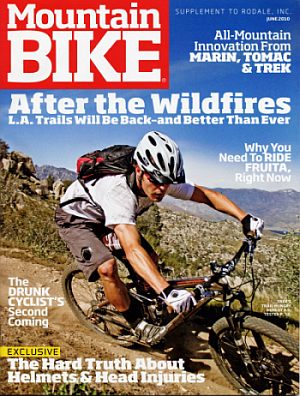
Messer made some special announcements regarding CORBA’s annual Fat Tire Fest, which will take place on October 17, 2010.  REI, Specialized, Fox, Mountain Bike Magazine, Mountain Bike Action and Hilton Hotels have already signed on as sponsors of this year’s event. The biggest change  for 2010 is that the Fat Tire Fest will feature a Cyclocross race presented by Back On Track Productions, in addition the full slate of regular Fat Tire Fest activities and festivities.

Fat Tire Fest registration will open in August along with the new web site at http://FatTireFest.com.

BikeSport Radio streams live at http://killradio.org
every other Monday at noon, and can be downloaded as a podcast from http://www.radio4all.net/index.php/program/44471.

Cyclists take on one of L.A.’s steepest hills

Monday, March 15th, 2010
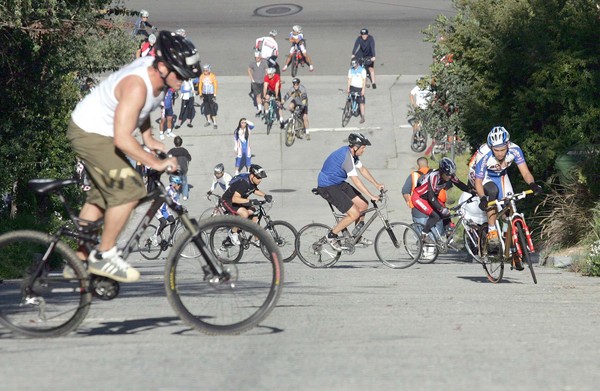
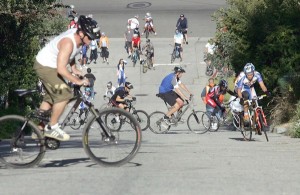
Climbing Fargo Street in Echo Park is no easy task. One woman tipped over and tumbled into a bush. Other riders used a zig-zag approach.

At a whopping 33% incline, Fargo Street is one of the sharpest grades in L.A. Many never made it to the top. One man climbed the peak 51 times in a day.  

From the Los Angeles Times  

There are people who sprint with the bulls in Spain, and people who plunge into icy oceans on New Year’s Day.  

Then there are the several dozen men and women who gathered in Echo Park on Sunday morning at the bottom of a beastly hill and looked up. Before them stretched Fargo Street, one of the city’s steepest roads.  

The challenge: to climb it. On a bicycle. Without stopping.  

Some tried and failed. Falls were so common that no one blinked when a woman tipped over halfway up the hill and tumbled violently into a bush on the side of the street.  

But many triumphed. More than half of the 105 people who signed up made it to the top, where they were greeted with cheers and dazzling views of Griffith Park and the Hollywood sign.  

Dan Wyman was one of them.  

His chest was still heaving from the ascent when someone asked him, “Why do you do it?”  

Wyman, 58, raised a hand in the air and said he needed a minute to cool down. “Sorry,” he said. “Nausea is overtaking me.”  

A couple of deep breaths later, he explained: “It’s not something you want to subject your body to. But the feeling when you conquer the hill is so special. You know you can do something no one else can do.”  

Wyman has participated in the Fargo Street Hill Climb almost every year since the inaugural event in 1974, when someone bet bicycle enthusiast Darryl LeVesque $100 that he couldn’t make it up Fargo Street.  

In front of a crowd of about 50 members of the Los Angeles Wheelmen bicycle club, LeVesque and his wife, Carol, got onto a tandem bicycle. As they were preparing for their climb, a man on a track bike made a sudden, unplanned run at the hill and cycled to the top.  

LeVesque, 64, who came to watch Sunday’s ride, said he still harbors resentment. “He was some young punk,” he said. “He stole our thunder.”  

The LeVesques hold the record for first tandem duo to make it to the top, and Carol holds the record for the first woman to make the solo ascent. The record for number of climbs made in one day is 101.  

Kent Karnes was this year’s top finisher, with 51 climbs.  

With a grade of 33%, the street is so steep that the Fire Department and car manufacturers are said to test equipment on it.  

Many people make adjustments to their bicycles, putting cogs as big as pie plates on their back wheel, and tiny chain rings on the pedal cranks, LeVesque said. Riding techniques vary. Some go straight up, while others crisscross their way to the top.  

“You’ve got to watch out for the zig-zaggers and for all the looky-loos on the side,” cyclist Hazziz Ali told Andres Morales, a younger cyclist who was considering making a run at the hill. “The biggest obstacles are the other people.  

“You can’t pace yourself,” Ali, 64, told Morales. “This is a sprint.”  

Morales, 32, couldn’t decide whether he should try the climb. He plans to run in the Los Angeles Marathon next week, and he didn’t want to injure himself before that. Besides, he said, looking up at the sharp incline, “it’s intimidating.”  

“Man, people give too much respect to this hill,” Ali told him. “The truth is, it’s about 1% physical and 99% spiritual.”  

“Yeah,” Morales said. “My old coach said it’s not the size of the body but the size of the heart.”  

When Ali pedaled away to warm up for his second ride, Morales said he had decided to bow out. “I think I’m going to skip it,” he said. “I’m going to ride to the beach.”  

At the bottom of the hill, Bruce Bates and his girlfriend sat on a guardrail, smoking cigarettes in the late-morning sun. Bates, whose bare chest was pink from sunburn, took swigs from a bottle of whiskey and loudly heckled the bicyclists.  

He said he had tried to ride the year before. “Halfway up I said, ‘Nope,’ and fell over backward.’ “  

His girlfriend said she wasn’t crazy enough to attempt the ride.  

“It would take me about three hours to get up the hill,” she said, “and there would be a lot of stopping.”
Google Maps adds bike routes

Thursday, March 11th, 2010

The mapping tool, added after bicyclists petitioned the company, provides turn-by-turn directions and even figures out routes that help cyclists avoid ‘unreasonable exertion.’

From the Los Angeles Times

After a long wait and more than 50,000 signatures on an online petition, cyclists will be happy to know that Google Inc. has finally added bicycle routes to Google Maps.

In Google Maps, users can now find “Bicycling” in the tool’s “Get Directions” drop-down box. After choosing the option, bikers can input two addresses and find the bike route that will get them to their destination. The mapping tool provides turn-by-turn directions and an estimated travel time.

The new Google Maps bicycling feature is available in 150 U.S. cities, including Los Angeles, San Francisco and New York. The tool features more than 12,000 bike trails. When users look for directions, the company’s mapping algorithm weights trails more heavily than roads for safety reasons. If cities have bicycle lanes, those are also weighted more heavily than roads without them.

One of the more useful features built into the Google Maps bicycling tool is its power-exertion calculation. According to the company, biking directions “compute the effort [bicyclists] will require and the speed [they will] achieve while going uphill.” Based on those calculations, the tool provides bicyclists with a route that eliminates areas that would require “an unreasonable degree of exertion.”

Google said its tool even keeps bicyclists away from busy intersections and areas where bicyclists would need to brake too often.

The Google Maps bicycling tool is in beta testing, which means it might have some bugs. Google plans to add more routes and trails in coming months.

Support Rails to Trails: Act would improve trail, walking and biking networks around the country

Wednesday, March 3rd, 2010

“Active Community Transportation Act of 2010″ Introduced in the U.S. House of Representatives

From Rails-to-Trails Conservancy

Please Speak Up for Critical Legislation for Trails, Walking and Bicycling

After years of organizing supporters around the country, Rails-to-Trails Conservancy (RTC) is excited to announce that on Tuesday, March 2, 2010, U.S. Rep. Earl Blumenauer (Ore.) introduced H.R. 4722, the “Active Community Transportation Act of 2010″ (ACT Act), on the floor of the House of Representatives!

The ACT Act is the direct result of Rails-to-Trails Conservancy’s (RTC) Campaign for Active Transportation. The Act would create a $2 billion program to fund dozens of communities around the country to improve their trail, walking and biking networks. If this bill is enacted, communities around the country will receive the resources to better allow Americans to walk and bike to the places you live, work, play, shop and learn.

Please encourage your representative to co-sponsor this very important legislation by filling in this petition.

NOTE: The following forward-thinking representatives have already signed on in support of the ACT Act:

  • Earl Blumenauer (Ore.)
  • Michael Capuano (Mass.)
  • Russ Carnahan (Mo.)
  • Steve Cohen (Tenn.)
  • Bob Filner (Cal.)
  • Daniel Lipinski (Ill.)
  • James Moran (Va.)

If your representative is one of the above seven individuals, instead of taking action below, please send a note thanking your representative for already supporting this legislation, and encourage him to continue pushing his colleagues for more support.

Don’t know who your representative is? Use the zip-code tool in the upper-left corner of www.house.gov—it’s easy!

Thank you.

Mountain Biking Grew 10.2% in 2008

Wednesday, December 2nd, 2009

The annual Outdoor Recreation Participation Report looks at year-over-year trends in various outdoor sports, based on the percentage of the population who participate in outdoor recreation in some form. Released earlier this year by the Outdoor Industry Foundation, the report shows a 10.2% increase in mountain biking from 2007 to 2008. Nationwide, the study reports 7,592,000 people who rode a mountain bike.

American’s most frequent outdoor activities were running (trail and pavement) with cycling (road, mountain and BMX) coming in second.  More people participated in outdoor activities than team sports. 15% of Americans rode a bike while 9% played basketball, 7% played football, 6% played soccer.

A disturbing downward trend in outdoor activity participation was seen among the youth over the past three years. In 2006 78% of 6 – 12 year-old children did some outdoor activity, but in 2008 only 64% did so. The 13 – 17 year-old group went from 69% participation in 2006 to 61% in 2008. The biggest drop was seen in girls aged 6 – 12, a 19% drop in participation over three years.

However, cycling (including road, bmx and mountain) remained both the “most popular” and “favorite” outdoor activity of the young. Despite the overall decline in outdoor activity participation, mountain biking among the 6 to 17 year-old age group grew by 17.4% over 2007 numbers, with over two million participants in 2008.

In the 18 to 24 year-old group mountain biking was down 23.8%. The biggest reason given was a “lack of time.”  Adult participation in outdoor activities grew from 48% to 53% in the 25 to 44 year-old group, and from 37% to 38% in those over 45 years of age.

Mountain biking is becoming more and more popular. These numbers underscore the need for us continue working towards opening new trails for this growing user group, and to take care of the trails we already have. We must also continue to get more youth involved in mountain biking, and support those who already do.

This study was based on a sampling of over 40,000 households. The complete report is available from the Outdoor Industry Association Foundation.

Physician convicted in bicycle crash case

Tuesday, November 3rd, 2009

from the Los Angeles Times

A physician accused of deliberately injuring two cyclists by slamming on his car’s brakes on a narrow Brentwood road was convicted Monday of mayhem, assault with a deadly weapon and other serious criminal charges.

Dr. Christopher Thompson is handcuffed by L.A. County Sheriffs after being found guilty on all 7 counts. (Mel Melcon / Los Angeles Times / November 2, 2009)

Dr. Christopher Thompson, 60, slumped forward and held his face in his hands after the verdicts were announced in a courtroom packed mostly with supporters and cyclists.

Deputy Dist. Atty. Mary Stone, who prosecuted the case, asked for Thompson to be jailed immediately, calling him a flight risk and a safety threat to cyclists.

“There’s not a cyclist in Los Angeles who would feel comfortable with this defendant out on the road after this verdict,” Stone told the court.

Los Angeles County Superior Court Judge Scott T. Millington ordered that Thompson be taken into custody. Thompson, wearing a dark blue suit, grimaced and shook his head as a bailiff cuffed his hands behind his back.

The veteran emergency room doctor, who spent more than two decades working at Beverly Hospital in Montebello, was also convicted of battery with serious injury and reckless driving causing injury. He faces up to 10 years in prison when he is sentenced Dec. 3.

The three-week trial in the Superior Court’s airport branch was watched closely by bicycle riders around the country, many of whom viewed the case as a test of the justice system’s commitment to protecting cyclists. The July 4, 2008, crash also highlighted simmering tensions between cyclists and motorists on Mandeville Canyon Road, the winding five-mile residential street where the crash took place.

Prosecutors alleged that Thompson stopped his car after passing the two cyclists and shouting at them to ride single file. The cyclists testified that they began maneuvering to ride one after the other when they noticed Thompson’s car approaching fast behind them but that the driver passed dangerously close before abruptly stopping.

Ron Peterson, a coach for USC’s and UCLA’s cycling team, was flung face-first into the rear windshield of the doctor’s red Infiniti, breaking his front teeth and nose and lacerating his face. Christian Stoehr, the other cyclist, hurtled to the sidewalk and suffered a separated shoulder.

A police officer testified that Thompson told him soon after the accident that the cyclists had cursed at him and flipped him off, so he slammed on his brakes “to teach them a lesson.”

Thompson testified that he never meant to hurt the riders. He said he and other residents were upset at unsafe cycling along the road, which has become an increasingly popular route for bicycle riders in recent years. But they had struggled to identify problem cyclists.

Thompson told jurors that the riders cursed at him and flipped him off when he yelled at them to ride single file. He stopped his car so that he could take a photo of the cyclists and believed he had left enough room for them.

But prosecutors alleged Thompson had a history of run-ins with bike riders, including a similar episode four months before the 2008 incident, when two cyclists told police that the doctor tried to run them off the road and braked hard in front of them. Neither of the riders was injured.

Outside court, the cyclists in the case said they were relieved at the outcome.

“Our hope is that this brings to light how vulnerable cyclists are out there,” Peterson, 41, told reporters. His face was permanently scarred from the crash and he underwent reconstructive surgery on his nose, which he said remains numb.

Stoehr, 30, said the crash left him unable to work for months and that he rarely rides his bike anymore. Nevertheless, Stoehr said he felt some sympathy for Thompson as he watched the physician being led away in handcuffs.

“It’s sad for both sides,” Stoehr said. “I lost a lot of my time and my life, and he’s losing a lot of his.”

Dirt Rag Magazine Credits CORBA with first volunteer mountain bike patrol group

Tuesday, September 1st, 2009

In an article on the history of IMBA‘s National Mountain Bike Patrol (NMBP), Dirt Rag magazine reviews the role CORBA had in spearheading volunteer mountain bike patrols. To quote:

“Although the NMBP was officially ‘started’ in 1994, volunteer mountain bike patrol’s roots run deep, back to the early days of mountain biking, when trails were rife with user conflict, and blanket mountain bike bans threatened great riding locations from coast to coast. The Concerned Off-Road Bicyclists Association (CORBA) was arguably the first organization to begin volunteer patrol activities with their Mountain Bike Unit (MBU), formed in 1988.

“Based in the Santa Monica Mountains, near Los Angeles, CORBA was at risk of losing many great riding venues. ‘Due to frequent complaints about user conflict, land managers were throwing their hands up,’ explains Blumenthal. ‘The [mountain bike advocacy] toolkit had to be developed quickly.’ So, with support from the National Park Service and the California State Department of Parks and Recreation, the patrol was formed, and became an overnight success, being nominated for the ‘Take Pride in California Award’ in 1991.”

Read the entire article, 15 Years of Service: A Look Back at IMBA’s National Mountain Bike Patrol.